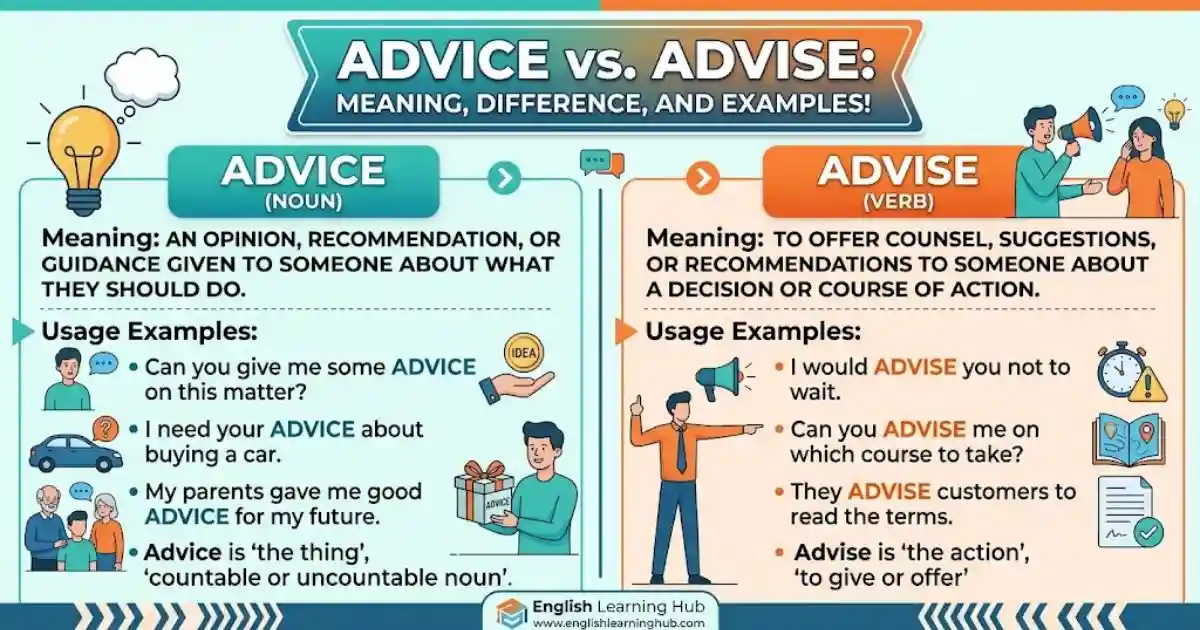
Choosing between advice or advise can be confusing because the two words look and sound similar but have different meanings and uses. Advice is a noun that means a suggestion, recommendation, or guidance, while advise is a verb that means to offer guidance or recommend an action.
For example, you can say, “I need your advice,” or “Please advise me on this matter.” Understanding this difference helps you avoid common grammar and spelling mistakes in emails, business messages, and everyday conversations.
This guide explains the meanings, pronunciation, and correct usage of advice and advise, with clear examples covering common phrases such as “please advise,” “legal advice,” and “thank you for your advice.” The main difference is that advice is a noun (a suggestion or opinion), while advise is a verb (the action of giving a suggestion or opinion).
Read Also : Molding or Moulding, Which Spelling Is Correct?
Key Differences
- Advice (Noun – spelled with a C)
Meaning: An opinion or recommendation offered about what you should do.
Pronunciation: Sounds like an “s” at the end (rhymes with ice).
Grammar: It is an uncountable noun (you cannot say “an advice” or “advices”). Instead, you use “a piece of advice”.
Example: “She gave me some great advice on my career.”
- Advise (Verb – spelled with an S)
Meaning: To give advice, recommend, or offer guidance.
Pronunciation: Sounds like a “z” at the end (rhymes with size).
Grammar: It is an action word that changes with tense (advise, advised, advising).
Example: “The doctor advised me to rest.”
Advice or Advise: Which Is Correct?
Both advice and advise are correct English words, but they serve different purposes. The right choice depends on whether you are talking about guidance or giving that guidance to someone.
Advice is a noun. It refers to an opinion, suggestion, or recommendation that can help someone make a decision. Advise is a verb. It describes the action of giving someone a suggestion or recommendation.
For example:
• “My teacher gave me helpful advice before the exam.”
• “My teacher advised me to study every day.”
In the first sentence, advice names the guidance. In the second, advised describes the action of providing it.
Read More: Lefty or Leftie: Which Spelling Is Correct in US English?
A simple way to remember the difference is to use advice for the information and advise for the action. This rule works in everyday conversations, professional emails, academic writing, and business communication.
What Is the Difference Between Advice and Advise?
The main difference between advice vs. advise is their grammatical function. Advice is a noun, while advise is a verb. Although they are closely related in meaning, you cannot always use one in place of the other.
| Feature | Advice | Advise |
| Part of speech | Noun | Verb |
| Meaning | Guidance or a recommendation | To give guidance or recommend something |
| Pronunciation | Sounds like “ad-vाइस” with an /s/ sound at the end | Sounds like “ad-vाइज़” with a /z/ sound at the end |
| Example | I need your advice. | Please advise me. |
| Common phrases | Legal advice, expert advice, financial advice | Advise someone, advise against, strongly advise |
Another important difference is that advice is uncountable in standard English. You would normally say “some advice,” “a piece of advice,” or “a lot of advice,” rather than “an advice” or “two advices.”
The verb advise, however, changes according to tense and subject. For example, you can write “I advise,” “she advises,” “they advised,” or “I will advise.”
Remember these two examples:
• Correct: “Thank you for your advice.”
• Correct: “Thank you for advising me.”
Both sentences are grammatically correct, but the first refers to the guidance received, while the second refers to the act of providing guidance.
Advice vs. Advise Examples in Sentences
Sentence examples make it easier to understand when to use advice or advise. Pay attention to the words around each term to identify its role.
Examples using advice:
• My parents always give me useful advice about life.
• I need your advice before accepting the job offer.
Examples using advise:
• I advise you to read the instructions carefully.
• The lawyer advised his client to review the contract. • The manager will advise the team before the meeting.
Some common expressions also become clearer when you understand the difference.
| Expression | Correct usage | Explanation |
| I need your advice or advise | I need your advice. | A noun is needed after “your.” |
| Please advice or advise | Please advise. | A verb is needed to request guidance. |
| Kindly advice or advise | Kindly advise. | “Advise” describes the requested action. |
| Thank you for your advice or advise | Thank you for your advice. | “Your” is followed by the noun. |
| Legal advice or advise | Legal advice | The phrase refers to legal guidance. |
| I would advice or advise | I would advise you. | “Would” is followed by the base form of the verb. |
One useful grammar test is to check whether the sentence needs a thing or an action. If you need a word for guidance, choose advice. If you need a word that describes giving guidance, choose advise.
Advice or Advise Meaning Explained
The words advice and advise are related, but their meanings work differently in a sentence. Advice refers to guidance that someone gives or receives. Advise describes the act of recommending a choice, sharing guidance, or warning someone about a possible action.
Both words are common in personal conversations, workplace messages, education, healthcare, and legal settings. Understanding their meanings helps you choose the correct word when asking for help, giving recommendations, or writing formal messages.
What Does Advice Mean?
Advice is a noun that means a suggestion, opinion, or recommendation offered to help someone decide what to do. It can come from a friend, family member, teacher, doctor, lawyer, or another person with relevant knowledge or experience.
Advice may help someone solve a problem, understand a situation, or choose between different options. It does not always have to be followed; the person receiving it can consider the suggestion and make their own decision.
Examples include:
• Career advice: My teacher gave me career advice before graduation.
In everyday English, advice is an uncountable noun. This means you should not usually add a directly before it or make it plural by adding s.
Use these forms:
• Correct: “She gave me some advice.”
• Correct: “I received three pieces of advice.”
• Incorrect in standard English: “She gave me an advice.”
• Incorrect in standard English: “He offered me three advices.”
If you want to describe the guidance as helpful, useful, valuable, or professional, you can place these adjectives before the noun. For example, “Her valuable advice helped me prepare for the interview.”
Read More: TubeHalote Meaning: Definition, Origin, and Examples!
What Does Advise Mean?
Advise is a verb that means to give someone guidance, make a recommendation, or suggest a course of action. It describes what a person does when they share information or recommend a particular choice.
The word often appears when someone offers guidance based on knowledge, experience, or professional judgment. It can also be used in formal communication to request information or instructions.
Consider these examples:
• The lawyer advised her client about the legal process.
• We strongly advise against sharing personal information online.
The verb changes form depending on the subject and tense.
| Verb form | Example |
| Advise | I advise you to be careful. |
| Advises | She advises students about their careers. |
| Advised | He advised me to wait. |
| Advising | They are advising the new employees. |
In formal emails, “Please advise” is a common expression. It means “Please provide guidance,” “Please let me know what to do,” or “Please tell me how to proceed,” depending on the context.
For example:
“Please advise on the next steps for completing the application.”
Here, advise is correct because the writer is asking someone to provide guidance or instructions.
However, advise does not always mean that someone is giving an order. It usually means offering a recommendation, although the strength of that recommendation depends on the context.
Advice or Advise: Common Grammar Rules
The easiest way to use advice and advise correctly is to understand their parts of speech and the sentence patterns they follow. Advice names the guidance itself, while advise describes the action of offering that guidance.
These rules are especially useful when writing emails, reports, applications, academic assignments, and everyday messages. They can also help you avoid common errors such as writing “please advice,” “an advice,” or “I would advice.”
Is Advice a Noun or a Verb?
Advice is a noun, not a verb. It names the guidance, recommendation, or suggestion that someone gives or receives.
Because advice is a noun, it often appears after words such as some, your, his, her, useful, or professional.
Examples include:
• I appreciate your advice.
• She gave me some helpful advice.
• We need professional advice before making a decision.
Advice can function as the subject or object of a sentence.
As the subject:
“Her advice helped me choose the right course.”
In this sentence, advice is the subject because it is the guidance that helped the speaker.
As the object:
“I followed my father’s advice.”
Here, advice is the object because it is the guidance the speaker followed.
There are three important rules to remember:
• Do not use advice as a verb. Write “Please advise me,” not “Please advice me.”
• Do not normally use a directly before advice. Write “some advice” or “a piece of advice.”
• Do not add s to make advice plural in standard English. Write “two pieces of advice,” not “two advices.”
These rules apply in both American and British English. The spelling of the noun remains advice in both varieties.
Read More: Treck Or Trek: Which Word Is Correct? What’s The Difference?
Is Advise a Noun or a Verb?
Advise is a verb, not a noun. It describes the act of giving guidance, making a recommendation, or suggesting what someone should do.
You can use advise with a person, an action, or a topic, depending on the sentence structure.
1. Advise someone to do something
This pattern is common when recommending a specific action.
Example: “I advise you to check the details before signing.”
2. Advise someone against something
Use this pattern when recommending that someone avoid an action.
Example: “The doctor advised him against strenuous exercise.”
3. Advise someone on something
Use this pattern when giving guidance about a particular subject.
Example: “The consultant advised us on business planning.”
4. Advise that something should happen
This structure is often used in formal or professional writing.
Example: “The manager advised that the meeting should be postponed.”
The verb also follows normal English tense rules. Use advise for the base form, advises with a third-person singular subject in the present tense, advised for the past tense, and advising for the continuous form.
| Sentence | Why it is correct |
| I advise you to wait. | The base verb follows “I.” |
| She advises new employees. | “Advises” agrees with “she.” |
| They advised us yesterday. | “Advised” expresses past action. |
| He is advising the team. | “Advising” follows “is.” |
| I would advise caution. | The base verb follows “would.” |
A common mistake occurs when writers confuse the noun with the verb in requests. For example, “Kindly advice” is incorrect when asking someone to provide guidance. The correct phrase is “Kindly advise.”
Similarly, write “I need your advice” when asking for guidance, but “I would advise you to wait” when recommending an action.
One final tip can help you remember the distinction: advice ends with the sound of s, while advise ends with the sound of z. Their pronunciation differs slightly, but their grammatical roles are the most reliable way to choose the correct word.
Advice vs. Advise Pronunciation
Although advice and advise have similar spellings and meanings, their final sounds are different. The word advice ends with an unvoiced /s/ sound, while advise ends with a voiced /z/ sound.
In simple terms, the final sound in advice is like the sound in “ice,” while the final sound in advise is like the sound in “eyes.” This difference is useful when speaking English and can also help you remember which word is a noun and which is a verb.
Both words have two syllables and are commonly pronounced with stress on the second syllable.
Does Advice End With an S Sound?
Yes. Advice ends with an /s/ sound, even though the word ends with the letter e. The final e is silent, and the letter c represents the /s/ sound.
The standard pronunciation is /ədˈvaɪs/, which sounds like “uhd-VICE.”
Examples of words with a similar final sound include:
• Advice: I need your advice before making a decision.
• Ice: The ice melted in the sun.
The word advice is a noun, so it refers to guidance, suggestions, or recommendations. Remembering its final /s/ sound can help you distinguish it from advise when speaking.
Why Does Advise Sound Like a Z?
Advise ends with a /z/ sound because the letter s represents a voiced sound in this word. Its standard pronunciation is /ədˈvaɪz/, which sounds like “uhd-VIZE.”
The difference is easy to hear when you compare the two words aloud. For the /s/ sound, air passes through your mouth without vibration in your vocal cords. For the /z/ sound, your vocal cords vibrate.
Examples include:
• Advise: I advise you to check the instructions.
• Rise: The sun will rise soon.
The word advise is a verb, meaning to recommend an action or provide guidance. Its final /z/ sound can help you remember that it describes an action rather than the guidance itself.
A simple pronunciation tip is to say advice with an /s/ sound and advise with a /z/ sound. The spelling difference is small, but the final sound helps distinguish the two words.
Read More: A Hour Or An Hour: Which One Is Correct? With Examples!
Commonly Confused Phrases
Advice and advise often cause mistakes in everyday conversations, workplace emails, and formal writing. The confusion usually happens when a sentence requires a noun but the writer uses a verb, or when a verb is needed but the noun is used instead.
Here are some common phrases and their correct forms.
| Incorrect or confused phrase | Correct phrase | Reason |
| Please advice me. | Please advise me. | A verb is needed. |
| I need your advise. | I need your advice. | A noun follows “your.” |
| Thank you for your advise. | Thank you for your advice. | The phrase needs a noun. |
| I would advice you to wait. | I would advise you to wait. | “Would” is followed by a verb. |
| She gave me an advice. | She gave me a piece of advice. | Advice is uncountable. |
| He advices me every day. | He advises me every day. | “Advises” is the correct present-tense verb form. |
| Thank you for advising. | Thank you for advising me. | Adding “me” makes the recipient clear when needed. |
The key is to look at the sentence structure rather than choosing a word based only on its spelling.
Use advice when referring to guidance as a thing. Use advise when someone gives guidance or when you ask them to provide it.
I Need Your Advice or Advise?
The correct phrase is “I need your advice.” The word advice is a noun, and it correctly follows the possessive word your. The phrase means that you want someone’s guidance, opinion, or recommendation about a situation.
For example:
“I need your advice about choosing the right university.”
In this sentence, the speaker is asking for guidance. Using advise would be incorrect because advise is a verb and does not fit the grammatical structure.
You can also say “I need advice,” “I need some advice,” or “I need a piece of advice.” All these expressions are correct, although the last one refers to a single suggestion.
Is It “I Need Advice” or “I Need Advise”?
“I need advice” is correct. The word need is followed by a noun in this sentence, so advice is the appropriate choice.
Compare these examples:
• Correct: “I need advice about my career.”
• Incorrect: “I need advise about my career.”
The difference depends on the sentence structure. In “I need advice,” the noun identifies what the speaker needs. In “I need you to advise me,” the verb describes the action the speaker wants someone to perform.
Here are a few other natural expressions:
• “I need some advice on managing my time.”
• “Could you give me a little advice?”• “I need your advice before accepting the offer.”
Remember that advice is an uncountable noun. Avoid saying “I need an advice.” Instead, write “I need some advice” or “I need a piece of advice.”
Is “I Need Your Advice” Grammatically Correct?
Yes. “I need your advice” is grammatically correct in both American and British English. It is a natural way to ask someone for guidance or a recommendation.
The phrase contains three main parts:
• I: The subject performing the action.
• Need: The verb expressing what the speaker requires.
• Your advice: The guidance the speaker wants.
Examples in different situations include:
• Personal: “I need your advice about a problem with my friend.”
• Formal: “I would appreciate your advice regarding this matter.”
If you want to sound more polite in a professional email, you can write, “I would appreciate your advice on this issue.” For a casual conversation, “Can I get your advice?” sounds natural.
The phrase “I need your advise” is incorrect because advise is a verb, not a noun. Replacing it with advice makes the sentence grammatically correct.
Read More: Leaves Or Leafs: When Each One Is Actually Correct!
Please Advice or Please Advise?
The correct expression is “Please advise.” It is commonly used in professional emails, business correspondence, and formal messages when someone wants guidance, instructions, or a recommendation.
The word please can be followed by a verb, and advise is the verb that fits this expression. By contrast, advice is a noun and cannot replace the verb in this sentence.
For example:
“Please advise on the best way to resolve this issue.”
This means the writer is asking the recipient to provide guidance. The expression is short and direct, although adding context can make the request clearer and more polite.
Is “Please Advise” Correct in American English?
Yes. “Please advise” is grammatically correct in American English. It is also used in British English and other varieties of English, particularly in professional communication.
The expression asks someone to provide information, guidance, or a recommendation. Its exact meaning depends on the surrounding message.
Examples include:
• “Please advise on how we should proceed.”
• “Please advise whether the documents have been received.”
In American business writing, please advise is often used when a decision or response is needed. However, it can sound brief or formal, especially when used without any explanation.
For a clearer and friendlier message, consider these alternatives:
• “Could you please let me know what I should do next?”• “Please share your recommendation when you have a chance.”
Choose the expression that best matches the relationship and situation. “Please advise” is correct, but a more specific request may help the recipient understand exactly what information you need.
Is “Kindly Advise” Grammatically Correct?
Yes. “Kindly advise” is grammatically correct and is commonly used in formal or professional correspondence. The word kindly functions as an adverb, while advise is the verb.
For example:
“Kindly advise whether the payment has been processed.”
The sentence asks the recipient to provide information about the payment. The word kindly adds a polite tone, although the overall expression may sound formal in some situations.
Other correct examples include:
• “Kindly advise on the next steps.”
Avoid writing “Kindly advice,” because advice is a noun and does not fit after kindly in this request.
If you prefer a more conversational style, you can use alternatives such as “Could you please let me know?” or “Would you please advise me?” Both are correct and may sound more natural in certain emails.
Thank You for Your Advice or Advise?
The correct expression is “Thank you for your advice.” In this sentence, advice is a noun that refers to the guidance someone has provided. The word your also signals that a noun should follow it.
For example:
“Thank you for your advice. It helped me make a better decision.”
Using advise in this phrase is incorrect because advise is a verb. You can use the verb in a different sentence, such as “Thank you for advising me,” where advising describes the action of giving guidance.
Is It “Thanks for the Advice” or “Thanks for the Advise”?
“Thanks for the advice” is correct. The phrase expresses appreciation for guidance or a recommendation someone has shared.
The word the is a determiner that can be used before the noun advice. The noun remains uncountable, but it can refer to specific guidance that the speaker has received.
Examples include:
• “Thanks for the advice. I really appreciate it.”
• “Thank you for the advice about my interview.”• “Thanks for the advice; I’ll keep it in mind.”
By contrast, “Thanks for the advise” is incorrect because advise is a verb and does not fit after the in this phrase.
You can also use the verb in a related expression:
“Thanks for advising me to wait before making a decision.”
Here, advising is correct because it describes the action the other person performed.
Both “Thanks for the advice” and “Thank you for your advice” are natural English expressions. The first is more casual, while the second can sound slightly more formal or personal.
Can You Say “Thank You for Your Advise”?
No. “Thank you for your advise” is grammatically incorrect. The correct phrase is “Thank you for your advice.”
The reason is simple: your needs a noun in this sentence, and advice is the noun that refers to guidance. Advise is a verb that describes the act of offering guidance.
Compare the following sentences:
• Correct: “Thank you for your advice.”
• Incorrect: “Thank you for your advise.”
If you want to thank someone in a professional email, you could write:
“Thank you for your advice and support. I appreciate your time and guidance.”
For a shorter, casual message, “Thanks for the advice!” is perfectly acceptable.
The main rule is to use advice when thanking someone for the guidance itself. Use advise or advising only when the sentence describes the action of giving that guidance.
Read More: ECT or ETC? Meaning and Definition, Example and Usage
Give Advice or Advise?
The correct expression is “give advice.” The word give is a verb, and advice is the noun that identifies what someone gives. The phrase means to offer guidance, suggestions, or recommendations to another person.
For example, “My teacher gave me good advice about preparing for exams.” In this sentence, advice refers to the guidance the teacher provided.
By contrast, advise is a verb that describes the act of offering guidance. You can say “My teacher advised me to prepare early.” Both expressions are correct, but their grammatical structures differ.
Understanding this distinction helps you avoid common mistakes in everyday English, academic writing, and professional communication.
Is It Correct to Say “Give Advice”?
Yes. “Give advice” is grammatically correct and is a common English expression. It means to share suggestions or recommendations that may help someone make a decision.
You can use the phrase in personal, educational, medical, and professional situations.
Examples include:
• My father often gives advice about making wise decisions.
Remember that advice is an uncountable noun. You can say “give advice,” “give some advice,” or “give a piece of advice.” Avoid saying “give an advice” in standard English.
You can also use advise to express the same general idea with a different sentence structure.
For example:
• “The teacher gave me advice about the exam.”
• “The teacher advised me to study carefully.”
The first sentence focuses on the guidance provided. The second focuses on the teacher’s action of recommending what to do.
How Do You Use Advise in a Sentence?
Use advise when you want to describe the action of giving guidance or recommending a course of action. It is a verb, so its form can change according to the subject and tense.
Common sentence patterns include:
Advise someone to do something
Use this structure to recommend an action.
• I advise you to read the instructions carefully.
• My parents advised me to save money.
Advise against something
Use this structure when recommending that someone avoid an action.
• The doctor advised against strenuous exercise.
• Our manager advised against making a rushed decision.
Advise someone on something
Use this structure when providing guidance about a particular topic.
• The expert advised us on improving our business plan.
• Her mentor advised her on career development.
Advise that something happen
This structure is often used in formal communication.
• The consultant advised that the meeting be postponed.
• The lawyer advised that the agreement be reviewed.
One useful grammar rule is that advise usually takes its base form after modal verbs such as should, could, and would.
For example, “I would advise you to wait” is correct, while “I would advice you to wait” is incorrect.
Advice Me or Advise Me?
The correct phrase is “advise me.” The word advise is a verb, and me is the object receiving the action. Together, they mean to provide guidance or recommendations to the speaker.
For example, “Please advise me on how to complete this application.”
The phrase “advice me” is incorrect in standard English because advice is a noun, not a verb. Although the two words have similar meanings and spellings, they cannot be used interchangeably.
This distinction is especially important when writing requests, emails, and formal messages.
Is “Please Advise Me” Correct?
Yes. “Please advise me” is grammatically correct. It is a polite request asking someone to provide guidance, information, or a recommendation.
Examples include:
• Please advise me on the best way to solve this problem.
• Could you please advise me about the application process?
The phrase can be used in professional emails and everyday conversations. However, the level of formality depends on the context.
For example, “Could you please advise me on the next steps?” sounds polite and professional. In a casual conversation, “Can you help me decide what to do?” may sound more natural.
You can also omit me when the recipient and subject of the request are clear.
For example, “Please advise on the next steps” is a common expression in business correspondence.
Read More: Drier or Dryer Which Spelling Is Correct? with Examples in
Why Is “Advice Me” Incorrect?
“Advice me” is incorrect because advice is a noun, while advise is a verb. In this sentence, the word before me needs to express an action, so the verb advise is required.
Compare these examples:
• Incorrect: “Please advice me about the job.”
The final two examples use advice correctly because it refers to the guidance being requested rather than the action of providing it.
A simple way to remember the rule is to look at the words around the term.
If you want to use me as the person receiving guidance, write “advise me.” If you want to name the guidance itself, use advice in a phrase such as “give me advice” or “share your advice with me.”
Advice You or Advise You?
When you want to recommend something directly to another person, the correct expression is “advise you.” The word advise is the verb that describes giving guidance, while you identifies the person receiving it.
For example, “I advise you to get enough rest before the exam.”
The expression “advice you” is incorrect when you intend to use the word as a verb. However, advice can appear before or after you in other grammatical structures, such as “My advice to you is to remain patient.”
Is It Correct to Say “I Advise You”?
Yes. “I advise you” is grammatically correct. It means that the speaker is offering guidance or recommending a particular action.
The phrase is often followed by to and a verb when the speaker wants to recommend a specific action.
Examples include:
• I advise you to check the details before signing.
• I advise you against making a rushed decision.
You can also use advise you in more formal contexts.
For example, “I advise you that further review may be necessary” is grammatically possible, although “I advise you that” can sound less natural than a more direct sentence in many contexts.
A clearer alternative might be “I recommend that you review the document again.”
Remember that advise changes form according to tense. You can say “I advise you” in the present tense, “I advised you” in the past tense, and “I will advise you” when referring to the future.
Can You Say “I Advice You to Rest”?
No. “I advice you to rest” is incorrect. The correct sentence is “I advise you to rest.”
The sentence needs a verb to describe the action of recommending rest. Since advise is the verb, it is the correct choice.
Compare the following examples:
• Incorrect: “I advice you to rest.”
• Correct: “I advise you to rest.”
• Correct: “My advice is to get enough rest.”
The difference becomes easier to understand when you separate the action from the guidance.
In “I advise you to rest,” advise describes what the speaker does. In “My advice is to rest,” advice names the recommendation itself.
For a natural sentence in everyday English, you could also say, “I recommend that you get some rest.” This conveys the same general idea without using either word.
Read More: Cringy or Cringey: Which Spelling Is Correct in US English
Professional and Specialized Usage
The difference between advice and advise is particularly important in professional settings. Medical, legal, and financial communication often involves recommendations, guidance, or formal requests, so choosing the correct word helps make messages clear and accurate.
Use advice when referring to guidance as information or a recommendation. Use advise when describing the act of giving guidance. The same distinction applies to business emails, payment documents, workplace instructions, and formal reports.
Doctor’s Advice or Doctor’s Advise?
The correct phrase is “doctor’s advice.” It refers to guidance or recommendations provided by a doctor. The apostrophe and s indicate that the advice comes from the doctor.
For example, “I followed my doctor’s advice and took time to rest.”
The phrase “doctor’s advise” is incorrect when referring to the doctor’s recommendations because advise is a verb. If you want to describe what the doctor did, you can use a sentence such as “The doctor advised me to rest.”
Should You Follow Your Doctor’s Advice?
Following your doctor’s advice can help you understand how to manage a health concern, use medication correctly, or decide whether further care is needed. Medical recommendations should be considered in light of your individual circumstances and discussed with a qualified healthcare professional when you have questions.
Examples of the phrase include:
• I followed my doctor’s advice about getting enough sleep.
• She asked for her doctor’s advice before changing her medication. • Please follow your doctor’s advice about your prescribed treatment.
The phrase can also be used in general discussions about healthcare. For example, “Always seek your doctor’s advice if you are unsure about a treatment.”
Use doctor’s advice when naming the guidance itself. If you want to describe the doctor’s action, use advise or its appropriate verb form.
How Do You Use “The Doctor Advised Me to Rest”?
“The doctor advised me to rest” is grammatically correct. The word advised is the past tense of advise, and it describes the recommendation the doctor gave.
The sentence follows this structure:
Subject + advised + person + to + verb
Here, the doctor is the subject, advised is the verb, me is the person receiving the recommendation, and to rest identifies the recommended action.
Other examples include:
• The doctor advised me to drink enough water.
• My doctor advised me to avoid strenuous activity.
You can express the same idea using the noun advice.
For example:
“The doctor’s advice was to get more rest.”
Both sentences communicate a recommendation, but their grammar differs. The first describes what the doctor did, while the second identifies the guidance the doctor provided.
Read More: Spicey vs Spicy: How To Spell It With Meaning & Examples
Legal Advice or Legal Advise?
The correct phrase is “legal advice.” It refers to guidance about laws, legal rights, obligations, or possible courses of action in a legal matter.
The phrase is common in discussions involving contracts, employment disputes, property matters, family law, and other legal issues. Since advice is a noun, it is the correct choice when referring to the guidance itself.
By contrast, advise is used to describe the action of providing that guidance. For example, “The lawyer advised me to review the contract before signing it.”
Is “I Need Legal Advice” Correct?
Yes. “I need legal advice” is grammatically correct. It means that someone wants guidance about a legal question or situation.
Examples include:
• I need legal advice before signing this agreement.
• She sought legal advice about an employment dispute.
• They contacted a lawyer for legal advice regarding property ownership.
The phrase legal advice is generally used when a person needs guidance specific to their legal circumstances. Legal rules vary by jurisdiction, so advice that applies in one place may not apply in another.
Remember that advice remains uncountable in this expression. Write “I need legal advice” or “I need a piece of legal advice” when referring to one recommendation. The first form is more natural in most situations.
Avoid writing “I need legal advise,” because the sentence requires a noun after need.
Should You Write “The Lawyer Advised Me”?
Yes. “The lawyer advised me” is grammatically correct. The word advised is the past tense of the verb advise, meaning the lawyer provided guidance or made a recommendation.
The sentence can stand alone when the context makes the subject of the advice clear. You can also add more detail to explain what the lawyer recommended.
Examples include:
• The lawyer advised me to read the contract carefully.
• My attorney advised me against signing the agreement immediately.
• The lawyer advised us on our legal options.
• She said her lawyer had advised her to seek further clarification.
• The lawyer advised that the documents be reviewed before submission.
Compare these two sentences:
• “I received legal advice from my lawyer.”
• “My lawyer advised me to review the documents.”
The first sentence uses advice as a noun. The second uses advised as a verb. Both are correct, but they emphasize different aspects of the situation.
Read More: Girlie or Girly: Meaning & Correct Usage With Examples For
Payment Advice or Payment Advise?
The correct expression is usually “payment advice.” In accounting and business communication, it commonly refers to information provided about a payment, such as its amount, date, reference number, or purpose.
A payment advice document or message may help a supplier or recipient identify a payment and match it to an invoice. Its exact contents and purpose depend on the organization’s procedures and the type of transaction.
The phrase “payment advise” is generally incorrect when used as a noun to name this document or information. However, advise can be used as a verb in a sentence about a payment, such as “Please advise us when the payment has been processed.”
What Does Payment Advice Mean?
Payment advice is a notice or communication that provides details about a payment. In many business settings, it helps the recipient understand which invoice or account a payment relates to.
For example, a company may send payment advice to a supplier after making a bank transfer. The notice might include the amount paid, the payment date, invoice references, and other relevant transaction details.
Common examples include:
• The supplier received payment advice after the invoice was settled.
• Please send the payment advice so we can identify the transaction.
Payment advice is not always the same as proof that money has reached the recipient’s bank account. Depending on the system, it may simply communicate that a payment has been initiated or provide information about how it should be allocated. If confirmation of receipt is important, check the transaction status with the relevant bank or payment provider.
Use payment advice when naming the notice or information. Use advise when asking someone to provide information or take an action related to a payment.
For example:
• Correct: “Please send the payment advice for this transaction.”
• Correct: “Please advise us when the payment has been completed.”
The first sentence refers to a document or notice. The second asks someone to provide an update.
Advice or Advise in the UK, USA, and Australia
The difference between advice and advise is the same in British, American, and Australian English. In all three varieties, advice is a noun that means guidance or a recommendation, while advise is a verb that means to give guidance or recommend an action.
Although spelling and vocabulary can vary between English-speaking countries, this particular distinction does not change by region. You should use advice when referring to guidance and advise when describing the action of providing it.
For example, “I need your advice” and “Please advise me” are correct in the UK, USA, and Australia.
Is Advice or Advise Correct in British English?
Both words are correct in British English, but they serve different grammatical purposes. The correct choice depends on the sentence.
Use advice as a noun:
• “Thank you for your advice.”
• “I need some advice about my university application.”
• “The teacher gave me a useful piece of advice.”
Use advise as a verb:
• “Please advise me on the next steps.”
• “The manager advised us to review the report.”
• “I would advise you to check the details.”
British English follows the same rule for formal letters, workplace emails, academic writing, and everyday conversations. The spelling of the noun is advice, while the base form of the verb is advise.
A common mistake is to assume that one spelling is British and the other is American. That is not the case. Both words are used in British English, and their grammatical roles determine which one is correct.
Read More: Puting Or Putting: Which Is Correct? A Complete Guide!
Do American and Australian English Follow the Same Rules?
Yes. American and Australian English follow the same advice-versus-advise rules as British English. The noun and verb are spelled the same way in all three varieties.
Here are examples of correct usage across the three countries:
| Context | Correct expression | Common setting |
| American English | I need your advice. | Everyday conversation |
| British English | Please advise me on the matter. | Formal correspondence |
| Australian English | She gave me some helpful advice. | Personal conversation |
| American English | The lawyer advised me to wait. | Legal discussion |
| British English | Thank you for your advice. | Professional email |
| Australian English | We advise customers to check the details. | Business communication |
Pronunciation may vary slightly by accent, but the basic distinction remains the same: advice ends with an /s/ sound, while advise ends with a /z/ sound.
The important point is that you should not choose between these words based on your country. Instead, identify whether your sentence needs a noun or a verb.
Sentence Patterns and Advanced Usage
Understanding sentence patterns makes it easier to use advice and advise correctly in longer or more formal sentences. The words often appear in phrases involving requests, recommendations, professional communication, and instructions.
Advice usually appears after words such as some, your, the, and valuable. Advise often follows please, would, should, or can, or appears in structures such as advise someone to do something.
Learning these patterns can help you write more naturally and avoid errors in business emails, applications, reports, and everyday messages.
As Per Advice or Advise?
The correct choice depends on how you complete the phrase, but “as per your advice” is grammatically correct. It means that something was done according to the guidance someone provided.
The word advice is a noun, so it fits after your. By contrast, advise is a verb and does not work in the phrase “as per your advise.”
For example:
“As per your advice, I contacted the customer and updated the report.”
This sentence means that the speaker followed the recommendation they received.
Is “As Per Your Advice” Correct?
Yes. “As per your advice” is grammatically correct and is often used in formal or professional communication. It indicates that an action or decision follows someone’s recommendation.
Examples include:
• As per your advice, I have revised the document.
• As per your advice, we contacted the supplier.
However, as per can sound formal or bureaucratic. In many situations, simpler expressions sound more natural.
For example, “Following your advice, I revised the document” communicates the same idea in a direct and professional way.
Avoid writing “as per your advise.” Since your requires a noun in this phrase, advice is the correct spelling.
What Are Better Alternatives to “As Per My Advice”?
The phrase “as per my advice” can be grammatically possible, but it may sound awkward depending on the context. If you are referring to guidance you previously provided, a more natural expression can make your meaning clearer.
Consider these alternatives:
• Following my advice, she changed her approach.
• As I recommended, the team reviewed the proposal.
• Based on my recommendation, we updated the plan.
• In line with my advice, he contacted the supplier.
• As discussed, I have completed the requested changes.
• As I suggested earlier, you should review the document.
Choose the wording that matches your intended meaning. If you are telling someone that you followed their recommendation, use “following your advice.” If you are explaining what you previously recommended to someone else, use “as I recommended” or “as I advised.”
Remember that advice names the guidance, while advised describes the action of providing it.
Advice to Rest or Advise to Rest?
The correct phrase depends on the sentence structure. “My advice is to rest” is correct because advice is a noun referring to a recommendation. “The doctor advised me to rest” is also correct because advised is the past-tense form of the verb advise.
These expressions communicate a similar recommendation but use different grammatical structures.
The phrase “advice to rest” can be used in a longer sentence, such as “My advice to you is to rest.” However, “advise to rest” generally needs a subject and an appropriate verb structure to make the sentence complete.
Is It Correct to Say “My Advice Is to Rest”?
Yes. “My advice is to rest” is grammatically correct. The noun advice identifies the recommendation, and the phrase to rest explains what the recommendation is.
You can use this structure to share guidance in personal, educational, or professional situations.
Examples include:
• My advice is to rest before the long journey.
• Her advice was to wait until the results arrived.
• My advice to you is to take your time.
• The teacher’s advice was to revise the notes carefully.
• Our recommendation is to review the information before deciding.
The structure is:
Advice + linking verb + recommendation
For example, in “My advice is to rest,” my advice is the subject, is is the linking verb, and to rest explains the recommendation.
You can also say “I advise you to rest.” The meaning is similar, but the grammatical structure changes because advise is a verb.
Is “The Doctor Advised Me to Rest” Correct?
Yes. “The doctor advised me to rest” is correct English. It uses the past tense of advise to describe a recommendation the doctor made.
The sentence follows the pattern subject + advised + person + to + verb.
Here are more examples:
• The doctor advised me to rest for a while.
• My physician advised me to avoid strenuous activity.
• The nurse advised him to contact his doctor if symptoms worsened.
• The doctor advised her to follow the treatment plan.
You can also express the same idea using the noun advice.
For example:
“The doctor’s advice was to get more rest.”
Both sentences are grammatically correct. The first emphasizes what the doctor recommended, while the second emphasizes the recommendation itself.
For medical decisions, follow guidance from a qualified healthcare professional who understands your circumstances. The examples above illustrate grammar rather than providing individual medical instructions.
Advise Further or Advice Further?
The correct expression is generally “please advise further.” In this phrase, advise is a verb asking someone to provide additional guidance, information, or clarification.
The phrase “advice further” is incorrect when intended as a direct request because advice is a noun, not a verb.
For example:
“Please advise further regarding the documents required for the application.”
This asks the recipient to provide more information or explain what should happen next. In some contexts, a more specific request may sound clearer and more natural.
Is “Please Advise Further” Correct?
Yes. “Please advise further” is grammatically correct, particularly in formal correspondence. It requests additional guidance or information about a matter already under discussion.
Examples include:
• Please advise further regarding the application process.
• Could you advise further on the documents we need to submit?
• Please advise us further if additional steps are required.
• We would appreciate it if you could advise further on this issue.
However, the phrase can sound vague if the recipient does not know what additional information you need. Adding the specific topic makes your request easier to understand.
For example, instead of writing “Please advise further,” you could write:
“Could you please explain which documents are required to complete the application?”
This version identifies the information you need and gives the recipient a clearer task.
Remember that advise is correct because the sentence requests an action. If you are referring to the guidance itself, use further advice, as in “Thank you for your further advice.”
How Do You Politely Ask Someone for Further Advice?
You can ask for additional guidance by using polite language that explains what you need. The best expression depends on whether you are writing a formal email, speaking to a colleague, or asking someone for personal guidance.
Here are some useful examples:
• Could you please provide further advice on this matter?
• I would appreciate your additional guidance regarding the next steps.
• Would you mind advising me further on this issue?
• Could you clarify your recommendation so I can proceed correctly?
• Please let me know if you have any further suggestions.
• I would be grateful for any additional advice you can offer.
Notice the difference between advise further and further advice.
“Please advise further” uses advise as a verb. “Please provide further advice” uses advice as a noun following the verb provide.
Both are correct when used in the appropriate sentence structure. In professional emails, a specific and polite request is often more effective than a brief expression without context.
Advice Request or Advise Request?
When referring to a request for guidance, “request for advice” is the clearest and most common expression. The word advice is a noun that identifies what the person is requesting.
The phrase “advice request” can also be used as a compound noun or label in certain contexts, such as a form or category for incoming requests. However, advise request is generally incorrect when you intend to name a request for guidance.
For example:
“I am writing to request your advice on this matter.”
In this sentence, request is the verb, and your advice is the guidance being requested.
Should You Write “Request for Advice”?
Yes. “Request for advice” is grammatically correct and is widely suitable for professional, academic, and personal communication. It means that someone is asking another person to provide guidance or a recommendation.
Examples include:
• I submitted a request for advice about the application process.
• The employee made a request for advice from the human resources team.
• We received a request for advice regarding the new policy.
• Her email contained a request for advice about choosing a course.
• The organization responded to the client’s request for advice.
You can also use the phrase in an email subject line, such as “Request for Advice on Project Planning.” This clearly identifies the purpose of the message.
In everyday communication, simpler wording may be more natural. For example, “I would like your advice on this project” is direct and easy to understand.
Avoid using “request for advise” when naming the guidance being requested. Since the phrase requires a noun, advice is correct.
Is “I Am Writing to Request Your Advice” Correct?
Yes. “I am writing to request your advice” is grammatically correct and appropriate for formal emails and professional correspondence. It politely explains that the purpose of your message is to seek guidance.
You can complete the sentence by identifying the topic.
Examples include:
• I am writing to request your advice on the proposed changes.
• I am writing to request your advice regarding the application process.
• I am writing to request your advice on how to proceed with this matter.
• I am writing to request your professional advice about the project.
• I am writing to request your advice before making a final decision.
For a more concise and natural email, you could write:
“I would appreciate your advice on the next steps.”
Or:
“Could you please advise me on how to proceed?”
Both alternatives are correct. The first uses advice as a noun, while the second uses advise as a verb.
Choose the version that best fits your audience and purpose. In either case, make sure that the word matches the grammatical structure of the sentence.
Advice or Advise: Common Mistakes and Examples
The most common mistakes involving advice and advise happen when writers confuse a noun with a verb. Since the words have similar spelling and related meanings, it is easy to select the wrong one when writing quickly.
The simplest rule is to remember that advice is guidance, while advise is the act of giving guidance. This distinction applies in everyday English, formal writing, professional emails, and academic work.
| Incorrect sentence | Correct sentence | Explanation |
| Please advice me. | Please advise me. | The sentence needs a verb. |
| I need your advise. | I need your advice. | A noun follows “your.” |
| Thank you for your advise. | Thank you for your advice. | The phrase refers to guidance. |
| I would advice you to wait. | I would advise you to wait. | “Would” takes the base verb. |
| She gave me an advice. | She gave me a piece of advice. | Advice is uncountable. |
| The doctor advice me to rest. | The doctor advised me to rest. | The past-tense verb is needed. |
| I advice you to be careful. | I advise you to be careful. | The sentence requires a verb. |
| Please give me an advise. | Please give me some advice. | The noun is uncountable. |
Why Are “Please Advice” and “I Need Your Advise” Incorrect?
“Please advice” is incorrect when used to request guidance because please is followed by the verb advise in this expression.
The correct form is “Please advise.”
Similarly, “I need your advise” is incorrect because your is followed by a noun in this sentence. The correct form is “I need your advice.”
Compare these examples:
• Correct: “Please advise me on the next steps.”
Each sentence uses the word that matches its grammatical role. Once you understand that difference, it becomes easier to identify and correct similar mistakes.
How Can You Remember When to Use Advice or Advise?
You can remember the difference between advice and advise by focusing on their meanings, grammatical roles, and final sounds.
Use advice when you mean guidance.
• “I need your advice.”
• “Thank you for your advice.”
• “The doctor’s advice was helpful.”
Use advise when you mean giving guidance.
• “Please advise me.”
• “I advise you to be careful.”
• “The manager advised us to wait.”
You can also use pronunciation as a memory aid. Advice ends with an /s/ sound, while advise ends with a /z/ sound.
Finally, try replacing the word with a simple explanation. If you mean “guidance,” choose advice. If you mean “to recommend” or “to give guidance,” choose advise.
With this rule in mind, phrases such as “give advice,” “please advise,” “legal advice,” and “I would advise you” become easier to use correctly in both everyday and professional English.
Conclusion
Understanding Advice or Advise becomes easy when you remember one simple rule: advice is a noun that means a suggestion or guidance, while advise is a verb that means to recommend or guide someone. Use “I need your advice” when asking for guidance and “Please advise” when requesting a response or recommendation.
This rule applies to American, British, and Australian English, including professional, medical, and legal contexts.
Before using either word, check whether your sentence needs a noun or a verb to keep your writing clear, correct, and natural.
FAQs About Advice and Advise
1. What Is the Difference Between Advice and Advise?
Advice is a noun that means guidance or a suggestion. Advise is a verb that means to recommend or guide someone. For example, “I need your advice” and “Please advise me.”
2. Is It “Please Advice” or “Please Advise”?
“Please advise” is correct because advise is a verb that asks someone to provide guidance or a response. “Please give me advice” is incorrect in standard English.
3. Should I Say “I Need Your Advice” or “I Need Your Advise”?
“I need your advice” is correct because the sentence requires a noun. Advice refers to the guidance you need, while advise describes the action of giving guidance.
4. Is It “Thank You for Your Advice” or “Thank You for Your Advise”?
“Thank you for your advice” is correct. The word advice names the guidance you received. Since “your” is followed by a noun in this phrase, “advise” is incorrect.
5. How Can I Remember When to Use Advice or Advise?
Remember that advice is a noun and advise is a verb. You can give advice, ask for advice, or follow advice. You can also advise someone, advise a colleague, or advise someone to take action.

Hi, I am the admin of GetIdioms.com. I handle everything on the site to bring you clear, fun, and useful idioms from around the world.