An or A is one of the most important English grammar rules, yet it often confuses learners because the correct choice depends on pronunciation, not just the first letter of a word. The indefinite articles a and an follow different rules based on vowel sounds, consonant sounds, silent letters, and spoken English.
For example, “an hour” is correct because the H is silent, while “a university” is correct because it begins with a “yoo” consonant sound.
This guide explains a vs. an with clear rules, everyday examples, common mistakes, exceptions, IPA pronunciation, and usage in American English, British English, writing, speaking, and ESL learning, helping you choose the right article with confidence.
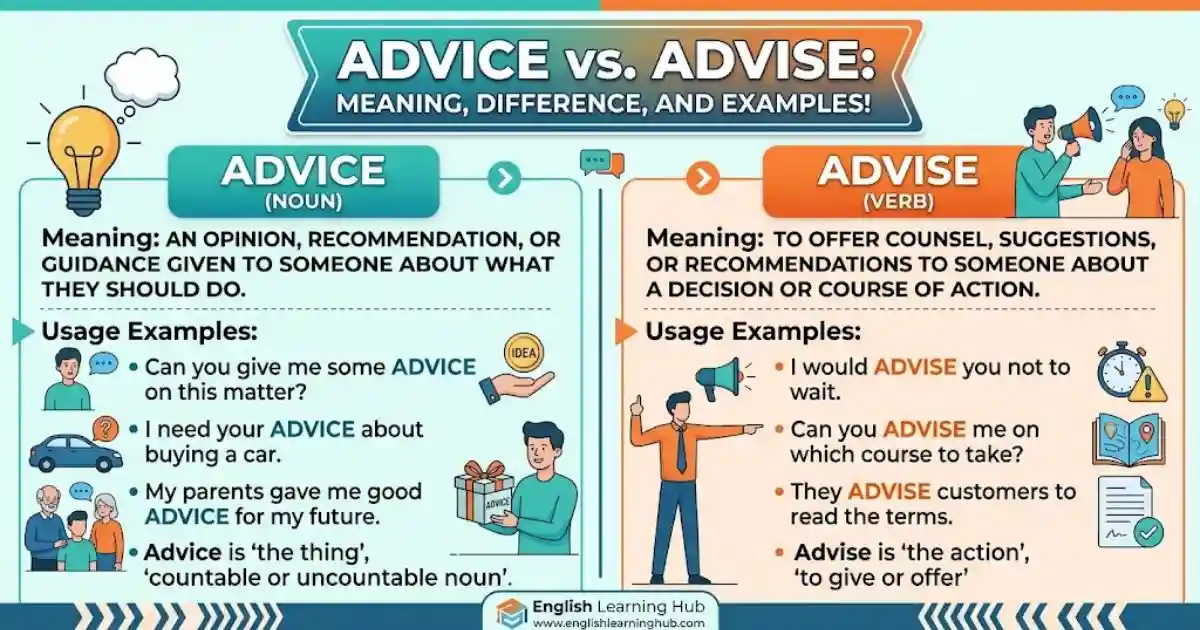
Read Also : Advice or Advise: Meaning, Difference, and Examples!
An or A: Meaning, Definition, and Difference
An or A Meaning and Definition
A and an are indefinite articles in English grammar. They are used before singular countable nouns when we talk about a person, place, object, or idea without identifying a specific one. The choice between them depends on the first sound of the following word, not simply its first written letter.
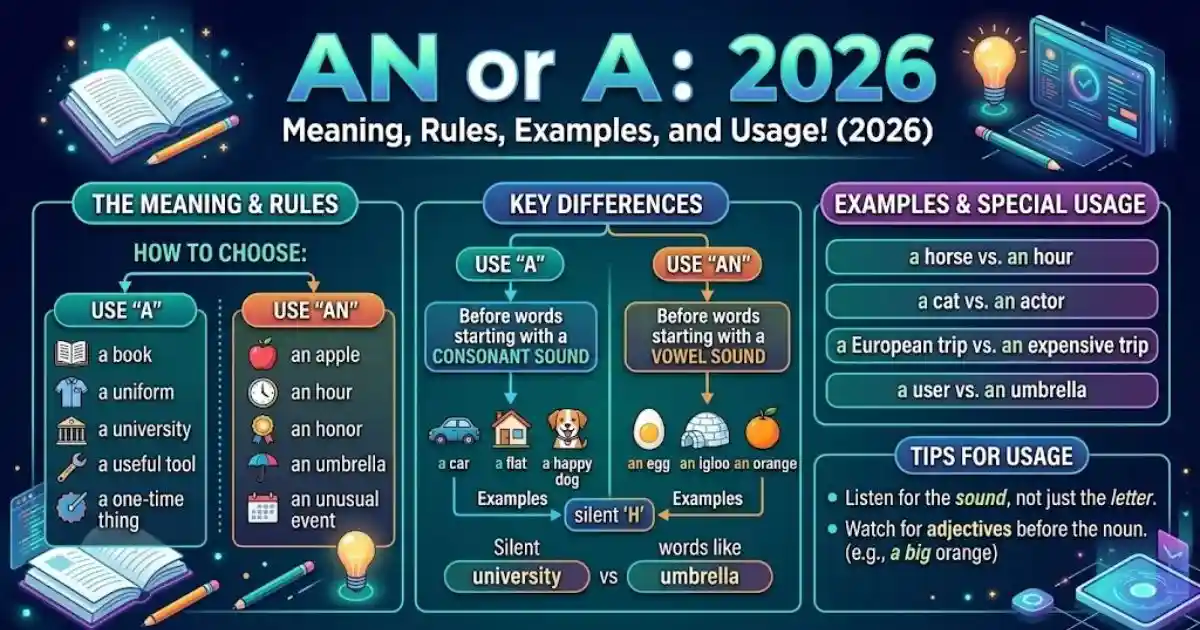
Use a before a consonant sound. For example, “a dog,” “a house,” and “a university” are correct. Use an before a vowel sound, as in “an apple,” “an umbrella,” and “an hour.”
These articles usually mean one person or thing, but they do not always emphasize the number one. Their main purpose is to introduce a noun that is not yet specifically identified.
Examples:
• I bought a book yesterday.
• She ate an orange after lunch.
• He wants to become a doctor.
• We waited for an hour.
Understanding this basic rule makes it easier to choose the correct article in everyday conversations, academic writing, emails, and professional documents.
A vs. An: Key Differences
The main difference between a vs. an is the sound that comes immediately after the article. Both words serve the same grammatical purpose, but they are used in different sound environments.
| Feature | A | An |
| Main rule | Before a consonant sound | Before a vowel sound |
| Example | A car | An egg |
| Silent-letter example | A European country | An honest person |
| Abbreviation example | A USB cable | An MRI scan |
| Grammatical role | Indefinite article | Indefinite article |
Compare these examples:
• A university is correct because “university” begins with a /j/ sound, similar to the beginning of “yes.”
• An umbrella is correct because “umbrella” begins with a vowel sound.
• A one-time offer is correct because “one” begins with a /w/ sound.
• An honest answer is correct because the “h” in “honest” is silent.
The written letters can sometimes mislead you. A word that begins with a vowel letter may need a, while a word that begins with a consonant letter may need an. Listening to the pronunciation is the most reliable way to decide.
Origin and History of A and An
Origin of the English Articles A and An
The history of a and an is connected to the development of the English language and the word one. In earlier stages of English, the ancestor of the modern indefinite article was a form of the numeral meaning “one.”
Old English used forms related to ān, meaning “one.” Over time, this word developed into forms that served both as a number word and as an article introducing a nonspecific noun.
As English changed, pronunciation became less complex in some positions, and shorter forms became common in speech. The modern words a and an reflect this historical development.
The connection with the number one remains visible today. For example, “I need a ticket” generally refers to one ticket, although the sentence focuses on the ticket rather than its number.
However, a and an are not interchangeable with the numeral one in every sentence. Compare “I bought a ticket” with “I bought one ticket.” The first simply introduces a ticket, while the second can emphasize the exact number.
This development illustrates how a word that originally expressed a number gradually acquired an important grammatical role in English.
Historical Development From Old English to Modern English
The English indefinite article developed over many centuries. Its history shows how changes in pronunciation, grammar, and everyday speech helped shape modern English usage.
Old English
Old English, spoken roughly from the fifth to the eleventh centuries, used ān for the number one. It also had a more complex system of noun endings and grammatical forms than modern English.
Middle English
During the Middle English period, roughly from the late eleventh to the fifteenth centuries, English underwent major changes. Many inflectional endings weakened or disappeared, and the forms associated with ān developed into shorter forms used before nouns.
Early Modern English
During the Early Modern English period, roughly from the late fifteenth to the seventeenth centuries, English spelling and grammar became more standardized through printing, education, and wider written communication. The use of a and an increasingly reflected familiar pronunciation patterns.
Modern English
In present-day English, the distinction follows the sound-based rule: a generally comes before consonant sounds, while an comes before vowel sounds. The rule applies across everyday speech, formal writing, journalism, academic work, and digital communication.
Although the basic distinction is well established, pronunciation can vary by accent. Some words may therefore be used differently by different speakers, especially when the initial sound is pronounced differently.
Read More: Lefty or Leftie: Which Spelling Is Correct in US English?
When to Use A or An
Use a or an before a singular countable noun when referring to something nonspecific, mentioning something for the first time, or describing a person’s job or identity.
1. Use A before a consonant sound
Examples include:
• A teacher explained the lesson.
• She bought a new phone.
• He lives in a small apartment.
• I need a pen to write this note.
• They adopted a puppy.
2. Use An before a vowel sound
Examples include:
• I ate an apple.
• She is reading an interesting book.
• He received an invitation.
• We saw an elephant at the zoo.
• She gave me an answer.
3. Pay attention to silent letters
Some words begin with written letters that are not pronounced. The spoken sound determines the article.
• An hour: The “h” is silent.
• An heir: The “h” is silent.
• A hotel: The “h” is pronounced in standard modern English.
• A historic event: The “h” is pronounced for most speakers.
4. Check the pronunciation of abbreviations
Initialisms and acronyms may require different articles depending on how their first spoken sound begins.
• An FBI agent: “F” is pronounced “eff,” which starts with a vowel sound.
• A NASA scientist: “NASA” is pronounced with a consonant sound at the beginning.
• An MRI scan: “M” is pronounced “em.”
• A USB drive: “U” is pronounced “you,” which begins with a consonant-like /j/ sound.
5. Remember that A and An cannot normally precede plural or uncountable nouns directly
Incorrect: She bought an apple.
Correct: She bought an apple.
Incorrect: He gave me useful information.
Correct: He gave me useful information.
Correct: He gave me a piece of useful information.
These rules cover most everyday situations. When you are unsure, say the noun aloud and listen to its first sound.
Read More: TubeHalote Meaning: Definition, Origin, and Examples!
Why A and An Are Called Indefinite Articles?
In English grammar, a and an are called indefinite articles because they introduce a noun without identifying a particular person or thing. They are different from the definite article the, which usually points to something specific or already known.
Consider these examples:
• I saw a bird in the garden. This introduces a bird without identifying which bird it was.
• The bird was sitting on a branch. This refers to the bird already mentioned.
• She wants to buy a laptop. She has not identified a particular laptop.
• She wants to buy the laptop we discussed. The laptop is now identifiable from the context.
The words a and an generally introduce singular countable nouns. They can also be used when describing professions, categories, and general characteristics.
For example, “My sister is a nurse” identifies her profession, while “An eagle is a bird of prey” places an eagle within a category.
In contrast, English normally uses no article with plural nouns and uncountable nouns when speaking generally. For example, “Books are useful” and “Water is essential” do not require a or an.
Understanding the difference between definite and indefinite articles helps you create clearer sentences and communicate whether a noun is general or specifically identified.
How An Evolved Into A Before Consonant Sounds?
The relationship between an and a reflects a natural pattern in spoken English. The older form associated with ān developed a shorter variant before many consonant sounds. This made speech easier by avoiding the need to pronounce an extra final consonant before another consonant.
Compare the rhythm of these phrases:
• An apple: The article ends with a consonant sound before a vowel sound.
• A book: The shorter article comes before a consonant sound.
• An old house: The article comes before the vowel sound at the beginning of “old.”
• A large house: The article comes before the consonant sound at the beginning of “large.”
The form remains useful before vowel sounds because it provides a smooth transition between words. The form a is shorter and fits naturally before consonant sounds.
This pattern is an example of how language often adapts to make common expressions easier to pronounce. Similar sound-based adjustments appear in other languages, although the exact rules differ.
Importantly, a is not simply a shortened version chosen according to spelling. Modern usage depends on the sound that follows it, which explains why we say “a university” but “an umbrella.”
Read More: Treck Or Trek: Which Word Is Correct? What’s The Difference?
Why English Uses Both A and An Today?
English continues to use both a and an because they help speakers connect words smoothly while preserving the same grammatical meaning. The choice depends on pronunciation, making the rule practical in both spoken and written English.
There are three main reasons for this distinction:
1. Smooth pronunciation
Using an before a vowel sound helps avoid an awkward transition between the article and the next word. For example, “an egg” is natural English, while “a egg” is not standard usage.
2. Consistent grammar
The distinction gives English speakers a predictable rule for introducing singular countable nouns. Once you recognize the initial sound, you can usually select the correct article without memorizing every word separately.
3. Flexibility across different words
English contains words with silent letters, unusual spellings, abbreviations, and borrowed forms from other languages. A sound-based rule allows the articles to work with all these word types.
For example, standard usage includes “a European city,” “an hour,” “a URL” when the letters are pronounced “you-ar-el,” and “an SOS signal” when the initialism is spoken beginning with “ess.”
Regional accents may affect the pronunciation of some words, but the principle remains the same: choose a before a consonant sound and an before a vowel sound. This simple rule makes article usage easier to understand, remember, and apply.
Grammar Rules for Using A and An
Use A Before Consonant Sounds
Use a before a word that begins with a consonant sound. A consonant sound is a sound made when airflow is partly or fully blocked by the mouth, lips, tongue, or teeth. This rule applies even when the word begins with a vowel letter.
Examples:
• She bought a car yesterday.
• He is a teacher at a local school.
• We visited a university last week.
• She gave me a useful idea.
• He waited for a one-time opportunity.
Words such as university, useful, and one begin with consonant-like sounds in standard pronunciation. That is why they take a, not an.
Remember that the first sound matters more than the first letter. If a word starts with a sound like /b/, /k/, /t/, /j/, or /w/, a is generally the correct choice.
Read More: List of Idioms: Common Expressions, Meanings, & Examples
Use An Before Vowel Sounds
Use an before a word that begins with a vowel sound. The main vowel sounds in English are associated with the letters A, E, I, O, and U, although the relationship between spelling and sound is not always direct.
Examples:
• I ate an apple after lunch.
• She received an email from her manager.
• He is an engineer.
• We saw an elephant at the zoo.
• They waited for an hour.
The word hour begins with a written H, but the H is silent in standard pronunciation. Its first spoken sound is a vowel sound, so an hour is correct.
The same rule applies to words that begin with other silent letters or abbreviations pronounced with a vowel sound.
For example, we say an honest person, an MRI scan, and an FBI agent because their first spoken sounds are vowels.
When choosing between a and an, pronounce the following word naturally. This is usually more reliable than looking at its spelling.
A or An Before Adjectives and Adverbs
When an adjective comes between an article and a noun, choose a or an according to the first sound of the adjective, not the noun that follows it.
Examples:
• She adopted a friendly dog.
• He bought an expensive car.
• It was a beautiful evening.
• They had an unusual experience.
• She is a talented artist.
In these examples, the adjective determines which article comes first. Even though artist begins with a vowel sound, “a talented artist” is correct because talented begins with a consonant sound.
An adverb can sometimes appear before an adjective, and the article may depend on the first sound of that adverb.
For example:
• It was a really interesting movie.
• She made an exceptionally good presentation.
• He had a very unusual idea.
In “a really interesting movie,” the first word after the article is really, which begins with a consonant sound. In “an exceptionally good presentation,” the first word is exceptionally, which begins with a vowel sound.
The practical rule is simple: look at the first pronounced word immediately following a or an.
A or An Before Singular Countable Nouns
The articles a and an are generally used before singular countable nouns when the speaker refers to a nonspecific person, place, object, or idea.
A countable noun names something that can be counted, such as a chair, an apple, a student, or an idea.
Examples:
• I need a chair for my desk.
• She wants an apartment near her workplace.
• He bought a notebook for school.
• We heard an interesting story.
• My brother is a doctor.
These articles also appear when introducing something for the first time. After the noun becomes identifiable, the definite article may be more appropriate.
For example:
“I saw a cat outside my house. The cat was sitting near the gate.”
The first sentence introduces an unidentified cat. The second refers to the same cat, which is now known from the context.
However, a and an do not normally come directly before plural nouns or uncountable nouns.
Incorrect: She bought an orange.
Correct: She bought an orange.
Incorrect: I need some advice.
Correct: I need some advice.
Correct: I need a piece of advice.
Understanding countable and uncountable nouns is an important part of learning English articles and avoiding common grammar errors.
Why Pronunciation Matters More Than Spelling?
English spelling does not always show how a word is pronounced. Some words begin with silent letters, while others start with vowel letters that represent consonant sounds. Therefore, pronunciation matters more than spelling when choosing between a and an.
Compare these examples:
| Correct phrase | Reason |
| A university | Begins with the /j/ sound, like “yes” |
| An umbrella | Begins with a vowel sound |
| A European country | “European” begins with a /j/ sound |
| An hour | The H is silent |
| A one-way street | “One” begins with a /w/ sound |
| An honest answer | The H is silent |
| A useful tool | “Useful” begins with a /j/ sound |
The same principle applies to abbreviations. The article depends on how the abbreviation is spoken rather than how it appears on the page.
For example, an MBA is correct because the letter M is pronounced “em,” which begins with a vowel sound. However, a URL is correct when the letters are pronounced “you-ar-el,” because the first sound is /j/.
To check your answer, read the phrase aloud at a normal speaking speed. Identify the first sound after the article, and then select the form that fits that sound.
A or An Before Tricky Words and Abbreviations
A or An Before U Words: University, Unique, and Umbrella
Words beginning with the letter U can take either a or an. The correct choice depends on whether the U represents a consonant-like sound or a vowel sound.
Use a when the word begins with the /j/ sound, as in “you.” Use an when the word begins directly with a vowel sound.
Use A:
• A university offers several degree programs.
• She found a unique solution to the problem.
• He is a useful member of the team.
• They live in a united community.
• It was a unanimous decision.
Use An:
• She carried an umbrella because it was raining.
• He is an undergraduate student.
• They discovered an unusual pattern.
• She gave an ultimatum to the company.
The difference is easy to remember when you focus on the first sound. University, unique, and useful begin with a /j/ sound, so they take a. Umbrella, undergraduate, and unusual begin with vowel sounds, so they take an.
Do not apply the rule based only on the letter U. Listen to how the complete word is pronounced.
A or An Before H Words: Hour, Honest, and Hotel
Words beginning with H can also create confusion because the letter is silent in some words but pronounced in others. The article depends on the sound used in the speaker’s pronunciation.
Use An before a silent H:
• We waited for an hour.
• She is an honest person.
• He became an heir to the property.
• It was an honorable decision.
In these examples, the H is silent in standard pronunciation, so the words begin with vowel sounds.
Use A before a pronounced H:
• We booked a hotel near the airport.
• She has a helpful colleague.
• He wore a heavy coat.
• They visited a historic building.
In most contemporary American and British English accents, the H is pronounced in hotel, helpful, heavy, and historic, so a is the usual choice.
Some older expressions and regional accents may use different pronunciations. For example, a speaker who drops the H in historic may use an historic event. This form occurs in some varieties of English, particularly in traditional or formal usage, but a historic event is standard for speakers who pronounce the H.
The safest approach is to follow the pronunciation you actually use.
A or An Before O Words
Words beginning with O generally take an when the O begins with a vowel sound. However, the sound of the word still determines the article, so pronunciation should remain your main guide.
Examples:
• She ate an orange after breakfast.
• He received an offer from a new employer.
• We watched an opera last night.
• They made an observation about the results.
• She is an optimistic person.
These words begin with vowel sounds, which is why an is correct.
Compare them with words in which a written O does not represent a vowel sound at the beginning. For example, the word once begins with a /w/ sound, so we say a once-in-a-lifetime opportunity.
The same pattern applies to other words beginning with one, such as a one-hour meeting. Although hour begins with a vowel sound when spoken alone, the article here comes before one, which begins with a /w/ sound.
Remember that the article is selected according to the first pronounced sound of the word or expression that follows it, not a later word in the phrase.
A or An Before European and One
The words European and one are common sources of mistakes because their written forms can lead learners to choose the wrong article.
European begins with the /j/ sound, similar to the beginning of “yes.” Therefore, use a European, not an European.
Examples:
• She is a European citizen.
• They visited a European capital.
• He studies at a European university.
The same rule applies to words such as Europe, European-style, and euphemism when they begin with the /j/ sound.
The word one begins with a /w/ sound, so it also takes a.
Examples:
• I need a one-dollar bill.
• She bought a one-way ticket.
• He gave us a one-time offer.
• We attended a one-hour workshop.
Notice that a one-hour workshop is correct because the first word after the article is one, not hour. Even though hour begins with a vowel sound, it does not determine the article in this phrase.
A useful memory trick is to say the word aloud. If European sounds as though it begins with “y” or one sounds as though it begins with “w,” use a.
A or An Before Acronyms: MBA, MRI, and URL
Acronyms and initialisms follow the same pronunciation rule as ordinary words. However, it is important to know whether the abbreviation is pronounced as a word or as a series of letter names.
MBA is commonly pronounced by saying the individual letters. Since M is pronounced “em,” it begins with a vowel sound. Therefore, an MBA is correct.
Examples:
• She earned an MBA in business administration.
• He is studying for an MBA degree.
MRI is also usually pronounced as individual letters. The letter M begins with a vowel sound, so use an MRI.
Examples:
• The doctor recommended an MRI scan.
• She underwent an MRI examination.
URL is often pronounced by naming its letters, with U beginning like “you.” That initial /j/ sound is consonant-like, so a URL is standard when the abbreviation is spoken that way.
Examples:
• Please send me a URL for the website.
• He copied a URL into the document.
Other common examples include:
• An FBI agent: F is pronounced “eff.”
• A NASA mission: NASA is usually pronounced as a word beginning with /n/.
• An SOS signal: S is pronounced “ess.”
• A USB cable: U is pronounced “you.”
The important point is that the abbreviation’s first spoken sound determines the article. If an organization or technical term has more than one common pronunciation, the appropriate article may depend on which pronunciation the speaker uses.
A or An Before Numbers and Initialisms
Numbers can also require a or an, depending on how the number is spoken. The written numeral itself does not determine the article.
Examples with numbers:
• She waited for an 8-minute break.
• He bought a 10-dollar notebook.
• We need an 11th-hour decision.
• They rented a 100-room hotel.
The correct article depends on the spoken beginning of the number. For example, eight begins with a vowel sound, while ten begins with a consonant sound. Similarly, eleven begins with a vowel sound, but one hundred begins with a /w/ sound.
Initialisms follow the same principle because their letters are spoken individually.
| Expression | Correct article | Reason |
| FBI agent | An FBI agent | F begins with “eff” |
| MRI scan | An MRI scan | M begins with “em” |
| USB cable | A USB cable | U begins with “you” |
| URL address | A URL address | U begins with “you” when spelled out |
| SOS message | An SOS message | S begins with “ess” |
| X-ray image | An X-ray image | X begins with “ex” |
These examples show why the article must match the spoken form, not the visual shape of a letter or number.
When writing technical documents, reports, or academic work, say the abbreviation or number as your readers are likely to say it. Then choose a before a consonant sound and an before a vowel sound.
A or An Examples, Usage, and Common Mistakes
A or An Apple, Hour, University, and Honest Person
The words apple, hour, university, and honest person are common examples used to explain the difference between a and an. Although their spelling may seem confusing, the correct article becomes clear when you focus on the first sound of each word.
• An apple: Use an because apple begins with a vowel sound. Example: She ate an apple before school.
• An hour: Use an because the H in hour is silent. Example: We waited for an hour.
• A university: Use a because university begins with the /j/ sound, like the beginning of yes. Example: He studies at a university.
• An honest person: Use an because the H in honest is silent. Example: Everyone trusts an honest person.
These examples show that the first written letter does not always determine the correct article. The pronunciation of the word is what matters.
A or An in Everyday English Sentences
In everyday English, a and an appear in conversations, text messages, emails, shopping situations, and descriptions of people or objects. They introduce singular countable nouns when the speaker does not refer to a specific item.
Here are practical examples from common situations:
• I need a pen to finish my homework.
• Can you bring me an umbrella?
• She adopted a small puppy yesterday.
• He ordered an iced coffee at the café.
• My brother wants to buy a bicycle.
• We watched an interesting movie last night.
• She is looking for a new apartment.
• I received an invitation to the party.
• He has a European friend who lives in London.
• We had an amazing experience during our trip.
A or An in Academic and Professional Writing
Correct article usage is important in academic essays, research papers, business reports, job applications, presentations, and professional emails. Although the basic rule remains the same, article errors can make formal writing appear less polished.
Use a before consonant sounds and an before vowel sounds, including when introducing a concept, method, result, or professional role.
Academic writing examples:
• The researcher proposed a new method for collecting data.
• The experiment produced an unexpected result.
• The study examines a common problem in education.
• The team developed an effective approach to data analysis.
Professional writing examples:
• She submitted an application for the position.
• We scheduled a meeting with the client.
• He prepared an annual report for the company.
• The manager suggested a useful strategy.
Articles also help introduce a concept before discussing it in greater detail. For example, “A researcher collected the data. The researcher then analyzed the results.” The indefinite article introduces the person, while the definite article refers to that same person afterward.
When proofreading professional documents, check both the article and the noun phrase that follows it. A grammatically correct sentence should use the appropriate article and match it to the actual pronunciation of the next word.
Common A and An Grammar Mistakes
Many English learners choose an article based on spelling alone or forget that adjectives can change which article is needed. Recognizing these patterns makes it easier to avoid errors.
| Incorrect usage | Correct usage | Explanation |
| An university | A university | Begins with a /j/ sound |
| A apple | An apple | Begins with a vowel sound |
| A hour | An hour | The H is silent |
| An honest man? | An honest man | The H is silent |
| An European country | A European country | Begins with a /j/ sound |
| A umbrella | An umbrella | Begins with a vowel sound |
| An useful tool | A useful tool | Begins with a /j/ sound |
| A interesting book | An interesting book | The adjective begins with a vowel sound |
| An one-time offer | A one-time offer | One begins with a /w/ sound |
| An MBA graduate | An MBA graduate | M is pronounced “em” |
One frequent mistake is choosing the article according to the noun instead of the adjective. For example, “a talented artist” is correct because “talented ” begins with a consonant sound, even though “artist ” begins with a vowel sound.
Another common error is using a or an directly before an uncountable noun. For instance, “an advice” is incorrect in standard English. Write “some advice” or “a piece of advice” instead.
Remember that the correct article depends on pronunciation, word order, and the grammatical type of the noun.
How to Correct Incorrect Article Usage?
Correcting any mistakes becomes easier when you follow a consistent checking process. You do not need to memorize every word individually. Instead, apply the sound-based rule to the word immediately following the article.
Use these steps when proofreading a sentence:
1. Find the article. Identify whether the sentence contains a or an.
2. Look at the next word. If an adjective or adverb comes first, consider its pronunciation rather than skipping ahead to the noun.
3. Say the word aloud. Listen to its first spoken sound.
4. Choose the correct form. Use a before a consonant sound and an before a vowel sound.
5. Check the noun. Make sure the article is appropriate for the noun phrase, especially when the noun is countable or uncountable.
Examples of corrected sentences:
• Incorrect: She bought an orange. Correct: She bought an orange.
• Incorrect: He is a university student. Correct: He is a university student.
• Incorrect: We waited for an hour. Correct: We waited for an hour.
• Incorrect: It was an unusual event. Correct: It was an unusual event.
• Incorrect: She gave me a useful suggestion. Correct: She gave me a useful suggestion.
This method works for everyday communication and formal writing. With regular practice, choosing between a and an becomes a natural part of speaking and writing English.
Linguistic Grammar and Regional Usage
Phonetics: Vowel Sounds vs. Consonant Sounds
Phonetics is the study of how speech sounds are produced, transmitted, and heard. It helps explain why English uses a before some words and an before others, even when their spelling appears similar.
Vowel sounds are produced without a major blockage of airflow through the vocal tract. Consonant sounds involve some narrowing or closure of the airflow. The distinction matters because the article depends on the first sound of the next word.
Examples include:
• An apple: The word begins with a vowel sound.
• A book: The word begins with the consonant sound /b/.
• A university: The word begins with /j/, a consonant sound often represented by the letter Y in English spelling.
• An hour: The initial H is silent, so the first pronounced sound is a vowel.
The International Phonetic Alphabet (IPA) can help describe these sounds accurately. For example, the first sound of university is commonly represented as /j/, while the first sound of apple is a vowel.
You do not need to learn the IPA to use articles correctly. However, understanding the difference between letters and speech sounds explains many otherwise confusing examples.
A and An in American and British English
The basic rules for a and an are the same in American English and British English. Both varieties generally use a before consonant sounds and an before vowel sounds.
For example, speakers in both varieties normally say:
• An apple
• A university
• An hour
• A European country
Some differences arise because pronunciation varies across regions, generations, and individual speakers. When the initial sound of a word changes, the preferred article may change with it.
One example is the word herb. In most standard American English pronunciation, the H is silent, so speakers commonly say an herb. In traditional British English pronunciation, the H is generally pronounced, so a herb is usual.
Another example is historic. Speakers who pronounce the H generally use a historic event. The expression an historic event also occurs in some varieties of English where the H is dropped or very weak.
These differences do not mean that American and British English follow separate article rules. They reflect the same grammatical principle applied to different pronunciations.
For clear writing, use the article that matches the pronunciation expected in your intended audience and remain consistent with the variety of English you are using.
A and An in Formal and Informal English
The rules for a and an remain the same in formal and informal English. The choice does not depend on whether you are writing an academic paper, sending a text message, or talking with a friend.
Formal examples:
• The committee approved an updated proposal.
• The company introduced a new policy.
• The researcher identified an important limitation.
Informal examples:
• I saw a funny video.
• She had an awesome day.
• Can you lend me a charger?
The tone and vocabulary may change across these settings, but the sound-based article rule does not.
In casual speech, speakers sometimes hesitate, repeat themselves, or use incomplete sentences. These features of spontaneous conversation do not change the standard grammatical rule.
For professional and academic writing, it is useful to proofread articles carefully because small errors can distract readers. In informal communication, correct usage still helps make your meaning clear and your English sound natural.
How Accents and Pronunciation Affect Article Choice?
English accents can influence how certain words are pronounced. Since a and an depend on the first spoken sound, regional and individual pronunciation differences can sometimes affect article choice.
For example, the word herb is pronounced with a silent H by many American English speakers but with a pronounced H by most British English speakers. This leads to an herb in the former pronunciation and a herb in the latter.
The word historic can also vary. A speaker who clearly pronounces the H will normally say a historic event, while a speaker who drops the H may use an historic event.
Other words, such as hotel, may have varied in pronunciation historically, but a hotel is standard in contemporary American and British English when the H is pronounced.
To choose the right article when speaking with a particular accent, follow these guidelines:
• Pronounce the word naturally in your own variety of English.
• Identify the first sound rather than relying on the written letter.
• Use a before a consonant sound and an before a vowel sound.
• Consider your audience when writing for a specific regional variety of English.
The central rule remains stable even when accents differ. Learning to recognize the first sound is more useful than trying to memorize separate rules for every accent.
Conclusion
Choosing An or A correctly depends on the sound that follows, not simply the first letter of a word. Use a before a consonant sound, as in“a university,” and an before a vowel sound, as in “an hour” or “an MBA.”
Understanding these English grammar rules, pronunciation patterns, and common exceptions helps you write more clearly and avoid frequent mistakes. With regular practice, you can use indefinite articles confidently in everyday conversations, academic work, and professional writing.
Frequently Asked Questions About An or A
1. Is It A or An Before a Vowel?
Use an before a vowel sound, as in “an apple,” “an egg,” and “an orange.” The rule depends on pronunciation rather than spelling. For example, “a university” is correct because university begins with a consonant-like /j/ sound, even though its first letter is U.
2. Is It A University or An University?
A university is correct because university begins with the /j/ sound, similar to the beginning of “yes.” Although U is a vowel letter, the initial sound is consonant-like. For example, “She studies at a university in London.”
3. Is It A Hour or An Hour?
An hour is correct because the H in hour is silent, so the word begins with a vowel sound. For example, “We waited for an hour.” Use an with other words that begin with a silent H, such as honest and heir.
4. Is It An MBA or A MBA?
An MBA is correct because the letter M is pronounced “em,” which begins with a vowel sound. For example, “He earned an MBA in business administration.” When choosing an article before an abbreviation, consider how its first letter or syllable is pronounced.
5. What Is the Simple Rule for A and An?
Use a before a consonant sound and an before a vowel sound. For example, say “a book,” “a European country,” “an apple,” and “an hour.” Always focus on the first spoken sound of the next word, not just its first written letter.

Hi, I am the admin of GetIdioms.com. I handle everything on the site to bring you clear, fun, and useful idioms from around the world.